

Surface-mounted and in-ground security systems can both protect people, property and vehicle access points, but they are installed differently. That difference affects excavation, construction disruption, project costs and how easily the protection can be changed or maintained over time.The best choice depends on ground conditions, underground services, security risks, required impact ratings, vehicle access and whether the installation needs to be permanent or adaptable.
What Are Surface-Mounted Security Solutions?
Surface-mounted security solutions sit on, or are fixed to, an existing concrete slab or finished surface rather than relying on deep foundations. Some surface-mounted security barriers are bolted down, while freestanding units require no ground fixings.
This makes them useful at completed developments, on suspended slabs and near underground utilities where excavation is restricted. Ezi Security’s surface-mounted security range includes crash blocks, mobile HVM barriers and security-focused street furniture.
The installation must still meet the product’s requirements. Bolt-down systems need suitable concrete for their fixings, while freestanding barriers require appropriate surface conditions and sufficient installation space.
What Are In-Ground Security Solutions?
In-ground security systems are secured within foundations below the finished surface. They generally involve excavation, reinforcement and concrete works, allowing the security installation to be integrated into the site’s design.
In-ground security bollards are particularly suited to new developments, major infrastructure projects and permanent vehicle entry points where foundation work can be planned early. Ezi Security’s M30 and M50 Static and Automatic Bollards illustrate the options: static bollards restrict vehicle entry, while automatic models lower to allow authorised vehicles through.

Surface-Mounted vs In-Ground: The Key Differences
The main differences are practical rather than a question of which system is stronger.
| Factor | Surface-Mounted | In-Ground |
|---|---|---|
| Excavation | Little or none for suitable products | Usually requires excavation |
| Foundations | Suitable existing slab or freestanding design | Engineered below-ground footing |
| Installation | Often quicker with less disruption | More groundwork and site coordination |
| Flexibility | Some systems can be moved or reconfigured | Generally difficult to relocate |
| Long-term use | Temporary or permanent, depending on product | Generally intended as permanent infrastructure |
| Cost | May reduce excavation costs | Foundation works can increase upfront costs |
Actual cost and installation time depend on the product, site preparation and required impact rating. Neither method is automatically cheaper or more secure.
When Surface-Mounted Security Is the Better Choice
Deep excavation can be difficult or impractical where underground services or drainage are present. Suspended slabs can also restrict the depth and type of foundations that can be installed. Surface-mounted security barriers may suit heritage sites, paved public areas and completed developments where major groundworks would disrupt normal use.
For example, Ezi’s Crash Block 30 and 40 are freestanding barriers that do not require foundations or ground fixings. This can be useful when protection needs to be installed without cutting into existing paving, provided the site’s layout and impact requirements suit the product.
When In-Ground Security Is the Better Choice
In-ground systems often make sense for permanent vehicle access points where routes are unlikely to change. They can also suit high-security facilities when the required impact rating and site conditions support an in-ground installation. On a new build, excavation, drainage and services can be coordinated with other construction works rather than added later.
For access points that must open to approved vehicles, Ezi’s Telescopic Bollard 30AT is an automatically rising bollard with a 500mm foundation depth. It provides a fixed installation while allowing controlled vehicle entry when lowered.
Consider the Ground Conditions Before Choosing a System
Before selecting bollards or vehicle security barriers, check the existing pavement, slab capacity, available foundation depth, underground services, drainage and space for construction equipment. A product that fits on a drawing may be impractical once buried services or structural limitations are identified.
Where deeper excavation is restricted, APT30SM surface-mounted bollards can be fixed to suitable existing concrete, including suspended slabs. Ezi’s APT40SH bollards use an ultra-shallow 125mm foundation. Both still require checks against the relevant installation and engineering requirements.
Does the Project Need Permanent or Flexible Protection?
Consider how the area will be used over the coming years. Public events, redevelopment works and changing vehicle routes may call for equipment that can be removed or repositioned, while stable access points may justify permanent infrastructure.
Ezi’s H-Stop® HVM Barrier can be wheeled into position by one person without ground fixings. Its 1,200mm unit is certified against a 3,500kg vehicle travelling at 48km/h, demonstrating that relocatable protection can still be crash-rated.
Where occasional vehicle access is needed, the IWA-14 Truckstopper 17 is available in a removable configuration, although its shallow foundation remains in place.
Security Rating Matters More Than Installation Method
A convenient installation method is of little value if the product cannot address the site’s vehicle threat. A Hostile Vehicle Mitigation (HVM) assessment should consider likely vehicle types, weight, approach speed and angle, and the acceptable distance a vehicle could travel beyond the barrier after impact.
Look for crash-rated security solutions tested to relevant standards, such as PAS 68, IWA 14-1 or ISO 22343-1, and check the specific configuration and test results. For example, Ezi’s freestanding Crash Block 40 is rated under IWA 14-1 for a 7.5-tonne truck travelling at 64km/h. Surface-mounted protection should not be dismissed solely because it lacks a deep footing.
Don’t Forget Aesthetics and Public-Space Integration
In shopping precincts, civic spaces and transport hubs, effective protection also needs to work for the people using the area. Barriers can be incorporated into seating or landscaping rather than appearing as a separate line of industrial hardware.
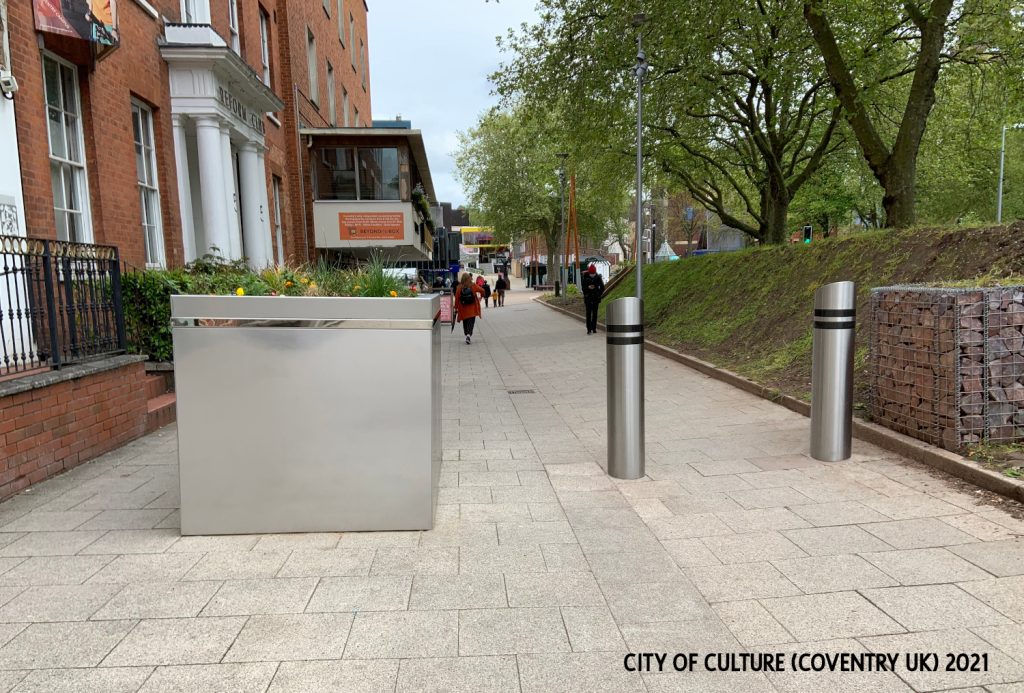
Ezi’s Crash Bench 40 combines seating with a crash-rated surface-mounted barrier. The Surface Mounted Planter 40 uses a freestanding planter design to bring HVM protection into existing streetscapes without ground fixings.
How to Choose the Right Security Solution for Your Project
Before deciding between surface-mounted and in-ground security, assess the whole site:
- Security risk: What vehicle threat, impact rating and penetration limit are relevant?
- Ground conditions: Are buried utilities, drainage or structural slabs limiting foundations?
- Installation: Can the site accommodate excavation, equipment and disruption?
- Vehicle access: Will vehicles need frequent, occasional or no entry?
- Future use: Might access routes change, or will protection remain permanently?
- Appearance and budget: What streetscape requirements and total installation costs apply?
These questions help narrow the options before product selection. They also identify when shallow foundation security barriers may offer a useful middle ground.
Surface-Mounted or In-Ground?
Surface-mounted solutions can reduce groundworks where excavation is restricted and offer flexibility where layouts may change. In-ground installations may be the better fit for permanent security and controlled access, particularly where foundations can be incorporated into a new project.
Ezi Security has over 30 years of experience in perimeter security, including the design, manufacture and installation of systems for vehicle and pedestrian access control.
The final choice should follow a site-specific security risk assessment, engineering review and assessment of day-to-day operations, not installation convenience alone.
Choose the Right Security Solution for Your Project
Every site has different ground conditions, security risks and installation requirements. Ezi Security provides surface-mounted, shallow-foundation and in-ground security solutions designed to protect people, vehicles and critical assets.
Need help choosing the right solution? Contact Ezi Security to discuss your project requirements.